Saturday, December 11, 2010

Short Trips: Model Train Set

BBC Audio. 1 episode, approx. 20 minutes. Written by: Jonathan Blum.


THE PLOT

The recently-regenerated 8th Doctor, investigating the TARDIS' study, finds himself bored with the amazingly complex, perfectly-coordinated model train set that was so prized by his previous incarnation. Through younger eyes, the movements of the trains seem so predetermined, the papier-mache settings along which the tracks run seem so lifeless. If he always knows exactly what is going to happen, then what is the point of even bothering to observe it?

That's when he's struck by a flash of inspiration. He uproots his predecessor's prize and distributes soil over the papier-mache to grow real grass over the green paint. He upgrades the trains and the model railroad workers, so that the model people can lay their own track and control the running of their own railroads. He is delighted to see the unpredictable patterns that emerge... but has he set loose something other than what he expected?


CHARACTERS

The Doctor: Jonathan Blum knows his 8th Doctor, and his 7th Doctor. This story effectively is a 20-minute commentary on both incarnations, contrasting the newly-born 8th Doctor against his predecessor. The 7th Doctor enjoyed the challenge of creating a perfect pattern, setting in motion a plan that would proceed exactly the way he wanted it to, even if that plan was simply the movements of some model trains.  By contrast, the 8th Doctor finds such absolute control stifling. He thirsts for something spontaneous, for surprises. The 7th Doctor has sometimes been accused of "playing God." But in this story, it is the 8th Doctor who takes the 7th Doctor's puppets and invests them with sufficient free will to create their own destiny. The results are more chaotic, but are perhaps more rewarding too. Blum also points to the 8th Doctor feeling more free in this younger incarnation, notably in a line in which the Doctor reflects how old he was at the end of his previous life, and that "he never wanted to be that old again."


THOUGHTS

Model Train Set is a very short piece, deceptively simple on the one hand and quite complex on the other. It is pure allegory, of course. Any listener or reader will quickly catch on that the 7th and 8th Doctors' approaches to the train set mirror their approaches to humanity, even without a few of the more heavy-handed narrative asides. But it's quite a rewarding allegory, charming and sometimes humorous. Blum, who has made no secret of his admiration of both the 7th and 8th Doctors, has crafted nothing less than a celebration of the 8th Doctor's exuberance for life, the enthusiasm that was the most defining single element of Paul McGann's performance in The TV Movie. It is easy to picture this Doctor reacting with childlike glee toward his renovated train set, and his emotional reaction to a setback in its development is something that rings true for this incarnation.

I enjoyed the story a lot, but there are points at which Blum's writing (generally quite strong) overeggs things a bit. An aside about how the 7th Doctor "made the trains run on time" is unnecessary and calls far too much attention to itself within a paragraph that would have been much stronger without it. Also, the overall allegory is clear enough without bits in which the writing spells it out for us by directly linking the model train set to humanity.

Occasional heavy-handedness aside, it's a good piece. Quiet, small, and perfectly characterized, it's an excellent use of the short story format to both contrast two Doctors and to celebrate the trait of the then-current Doctor. The audio version of the story (available as part of Tales from the TARDIS, volume 2, and previously in the audio version of Short Trips & Side Steps) is extremely well-read by Sophie Aldred, who has a lovely reading voice for a story that is mostly narration, and further benefits from well-chosen music that is very well-applied.

It's a small piece. But judged as a small piece, it's a genuinely impressive one.


Rating: 9/10.

Preceded by: The TV Movie

Search Amazon.com for Doctor Who

4th Doctor Audio Review Index

4th Doctor Television Review Index


BBC Classic Series Audios Review Index

To receive new review updates, follow me:

On BlueSky:

On Threads:

Short Trips: Glass

Not Yet Reviewed.

Short Trips: Freedom

Tales from the TARDIS CD cover.

1 episode. Running Time: Approx. 30 minutes. Written by: Steve Lyons. Performed by: Nicholas Courtney, Sophie Aldred.


THE PLOT:

The Master has finally been captured. He planned for this contingency, however. The Doctor, Jo, and UNIT soon learn that he spent his time on Earth hypnotizing people specifically to break him out if he was ever imprisoned. They're able to stop the escape fairly easily - a little too easily, in the Doctor's opinion, with him certain that his rival's plans are far from over.

The hypnotized people all worked for the same employer: The Freedom Corporation, which has just announced a breakthrough in time travel. The Doctor attends a demonstration, only to determine that the touted science is nonsense. But when he and Jo follow the lead scientist, they fall into a trap.

The Master has set up the perfect prison for the Doctor and Jo, one from which they cannot escape. He tells the Brigadier that he will return them under one condition:

His freedom!


CHARACTERS:

The Doctor: He feels some empathy for the Master. His exile on Earth already feels like a prison to him, so he can only imagine how the Master must feel at being confined to a single cell. The Doctor gets a chance at freedom late in the story, and he is explicitly tempted to take it, even though it means abandoning Earth to the Master's latest scheme. He doesn't waver long, but the temptation is real and makes for the story's single best character moment.

Jo Grant: She recognizes how badly the Doctor wants his freedom, and she feels guilt when she pleads with him to give up that freedom to stop the Master. She reflects that she wouldn't ask if she saw any other way. Sophie Aldred voices Jo's lines in the audio version, which doesn't quite work for me. It's not that she doesn't sound like Katy Manning (Nicholas Courtney doesn't particularly sound like Jon Pertwee, and yet his performance works well) - It's that her voice is just 100% wrong for Jo, and that sometimes pulled me out of the story. If they couldn't get Katy Manning in, then I think this story should have been read solely by Courtney.

The Master: Even as he sowed chaos across Season Eight, he also prepared a dual contingency plan. The first, simpler plan goes into effect the instant he's captured, as the prison is besieged by scores of people in whom he planted a hypnotic suggestion to break him out. He fully expects it to fail, but it acts as a cover for the plot involving the Freedom Corporation. When he traps the Doctor, he allows his bitterness at his imprisonment to show, telling his foe that he hopes he enjoys his prison as much as the Master enjoyed his.


THOUGHTS:

Steve Lyons' Freedom acts as a postscript to Season Eight. It makes sense that the Master would have tried to escape in between his capture at the end of the The Daemons and his final, successful breakout in The Sea Devils. There's some cleverness in the Master's plan, and the characters of the Doctor and the Master are well-realized.

The only significant weakness is a common one among Short Trips: It should have been slightly longer. The story is efficiently structured. The narrative moves back and forth in time, with scenes of the Doctor and Jo in the Master's prison interspersed with the events leading up to their capture. All the necessary beats are there, but some of them are given no time to really make an impact before the story hurtles on to the next one. The audio version of this story runs an even half hour; I think it would have felt less rushed had it been allowed just ten more minutes.


OVERALL:

Outside of wishing it had been a bit longer, I found Freedom to be very enjoyable. Nicholas Courtney does his usual fine job as narrator, and he brings both Doctor and Master to life effectively, which offsets my issues with Sophie Aldred's Jo. The story also feels entirely of a piece with the televised Pertwee era.


Overall Rating: 7/10.

Previous Television Story: The Daemons
Next Television Story: Day of the Daleks


Search Amazon.com for Doctor Who

3rd Doctor Audio Review Index

3rd Doctor Television Review Index

BBC Classic Series Audios Review Index

To receive new review updates, follow me:

On BlueSky:

On Threads:

The Ghosts of N-Space

CD cover for The Ghosts of N-Space.

6 episodes Running Time: Approx. 143 minutes. Written by: Barry Letts. Directed by: Phil Clarke. Produced by: Phil Clarke.


THE PLOT:

Brigadier Lethbridge-Stewart's Italian great uncle, Mario (Harry Towb), has a problem. That problem's name is Max Vilmio (Stephen Thorne), a New York mobster who is intent on taking possession of Mario's castello on the island of San Stefano Minore, just off the coast of Sicily. This is nothing he'd anticipate having a problem dealing with... until he glimpses a creature flying just outside Mario's window, which his uncle describes as one of several "little fiends from Hell."

The Doctor, Sarah Jane, and Jeremy Fitzoliver come out to the castello, where they soon see apparent ghosts - not only the fiends, but also a "white lady" falling from a cliffside while calling out for her lover. The Doctor realizes that the castello is the site of a tear between the fabric of the normal universe and "N Space," which exists outside the space/time continuum. The Doctor fears that the tear in the barrier is growing and will soon result in catastrophe, with demonic "N Forms" spilling out into their universe.

He lashes up a device that allows him and Sarah to explore N Space to find the source of the damage. They glimpse two time periods, one in the early 19th century and another roughly 300 years prior. They then set off in the TARDIS to try to stop the disaster from occurring.

Meanwhile, Max Vilmio prepares to lay siege to the castello, using powers that should be beyond the ability of any human to advance his goal...


CHARACTERS:

The Doctor: He is able to quickly ingratiate himself to the castello's residents in both of the past periods. He befriends Paolo (Paul Brooke), the barone in the 19th century, who eventually helps him to figure out the larger scale of what's happening. He attempts to provoke the main villain in the 1300s, only to outsmart himself and end up locked up alongside Sarah Jane. There's a nice moment late in the story when Sarah becomes distraught. Much as he used to do with Jo, he distracts her by telling her stories about his old teacher on Gallifrey, making her laugh before ending with direct reassurance.

Sarah Jane Smith: She somehow was delusional enough to not only submit the events of Death to the Daleks to her editor, but to be surprised at its rejection, in a bit that seems to exist solely to crowbar in an unnecessary continuity placement. She also thinks fast to save the Doctor from some falling masonry at the end of Episode Two. Her most prominent trait in this story is compassion. She befriends Louisa (Deborah Berlin), Paolo's ward, in the 19th century, and also befriends Guido (Jim Sweeney), the son of the duke in the 13th century - the latter of whom ends up being the key to her and the Doctor escaping from that time period.

Brigadier Lethbridge-Stewart: Though he has no interest in inheriting his great uncle's title, family duty brings him to the castello. When he first comes face to face with Max Vilmio, he stops the mobster from pushing his way into the house, forcefully telling him that Mario is "not at home to you, sir," and he makes clear that he finds Vilmio to be neither impressive nor intimidating. When Vilmio later attempts to lay siege, the Brigadier organizes a defense, showing absolute competence throughout.

Jeremy Fitzoliver: Though I still find the character to be ill advised, he's at least more tolerable than in The Paradise of Death. He speaks more like a human being, and he's wisely kept in the "B" plot, helping the Brigadier, while the Doctor and Sarah are paired for the main story. Also, he actually is helpful at a couple of points, as opposed to the earlier story making him little more than human baggage. Don't get me wrong, he's still annoying - but he's graduated from Jar Jar Binks to second season Wesley Crusher.

Max Vilmio: I'm not sure why writer Barry Letts decided to make him from New York. The story is set in Sicily. Why not just make him a Sicilian mafia boss? It would be simpler, and it would increase the immediate threat of Vilmio if he was operating from what's already a seat of power for him. Stephen Thorne plays two villainous roles, Vilmio and a malicious alchemist in the past. He is much better as the alchemist, speaking in his natural voice, than as the New York mobster with the cartoonish accent.


THOUGHTS:

I don't know for sure if this is true or an exaggeration, but I have read that The Ghosts of N Space exists because of a mistake.

When 1993's The Paradise of Death was rebroadcast the following year, two of its episodes aired out of order. Complaints came in, as expected. What wasn't expected what the sheer volume of complaints, leading to the realization that there had been a much wider audience for the Doctor Who radio serial than expected. Supposedly, this was what led to the commission of a sequel, reteaming writer Barry Letts, producer/director Phil Clarke, and the Season Eleven team of Jon Pertwee, Elisabeth Sladen, and Nicholas Courtney.

The Ghosts of N Space tends to be poorly regarded within fandom. It certainly gets off to a bad start, with Sarah and Jeremy running into the Brigadier through a dramatically implausible coincidence when it would have been less cumbersome and more internally believable to have them simply accompany the Doctor. Also, the mafia thread, by far the story's worst, is at its most prominent in the first episode, burdening the opening installment with a flood of bad New York accents.

After the first episode, though, the story gets better. The mafia material moves far to the background, with the bulk of the focus going to the Doctor and Sarah and their trip to the past. The action is centered around a single castello across three time periods. Compared to The Paradise of Death, this more controlled setting makes the story more narratively focused and easier to visualize. There's even some structural cleverness, with the Doctor and Sarah witnessing effects in both the present and the 1800s of events from the 1300s - incidents that, from their viewpoint, have yet to occur.

Because the setting is much narrower than in the previous radio serial, there's more time to explore both the place and the guest characters. The friendship Sarah strikes up with young Louisa is charming, and I connected with Sarah's fondness for this naively earnest young woman. Also, all of the shifts among time periods felt well motivated, keeping the pace moving without losing the sense of it being a single, interconnected story.

The climax is overbaked, with the Doctor having two different confrontations with the villain when one really should have been enough. The first of these is quite good, and it would have been a fine note to have wrapped up the plot with. The second climax more or less repeats the same beats and themes, only with an increase in speeches and shouting, and its inclusion is a misstep.


OVERALL:

Though it's marred by a poor first episode and some terrible accents (both American and Italian), I still found myself enjoying The Ghosts of N-Space more than I enjoyed The Paradise of Death. It moves along, with a couple of nicely atmospheric moments, and I enjoyed the way the story spanned three different time periods in the same location.

It certainly doesn't rank among the better Doctor Who audios... but I also wouldn't rate it among the worst. It's a flawed story, but one that I largely enjoyed.

That first episode is genuinely horrible, though. If you're interested in tracking it down (and it's pretty cheap on most audio streaming services), then be prepared to grit your teeth through the entirety of Part One.


Overall Rating: 6/10.

Previous Television Story: Death to the Daleks
Next Television Story: The Monster of Peladon

Search Amazon.com for Doctor Who

3rd Doctor Audio Review Index

3rd Doctor Television Review Index

BBC Classic Series Audios Review Index

To receive new review updates, follow me:

On BlueSky:

On Threads:

The Paradise of Death

CD cover for The Paradise of Death.

5 episodes. Running Time: Approx. 143 minutes. Written by: Barry Letts. Directed by: Phil Clarke. Produced by: Phil Clarke.


THE PLOT:

UNIT is called to investigate after a badly brutalized body is discovered just outside Space World, a new amusement park in London. The Doctor and Brigadier Lethbridge-Stewart determine to go a pre-opening publicity exhibition. Also going is the Doctor's newest friend, journalist Sarah Jane Smith - and her photographer, the inexperienced and thoroughly inept Jeremy Fitzoliver (Richard Pearce).

Space World is owned by the Parakon Corporation, operated by Chairman Freeth (Harold Innocent) and security conscious Vice Chairman Tragan (Peter Miles). They present themselves as simple executives, but it isn't long before the Doctor confirms that they are extra-terrestrials. Freeth admits this, but he insists that they are on Earth for "an ordinary commercial venture," which his corporation has negotiated with Earth's leaders to create a peaceful first contact situation.

It's a convincing enough story... except that even as Freeth tells it to the Doctor and the Brigadier, Tragan takes off for their home planet, with a busily snooping Sarah Jane as an unwitting stowaway!

The Doctor, the Brigadier, and Jeremy pursue in the TARDIS and (eventually) find their way to Parakon, where they're reunited with Sarah at the palace of the President (Maurice Denham). He is a decent enough man, but it's clear that he's grown inattentive in his old age, content to leave the business of government to his son and heir - Freeth.

The President believes that his planet is a paradise, its people enjoying an existence of idle content after the discovery of miracle plant Rapine. His housekeeeper, Onya (Jane Slavin), fills them in on the real state of things. The cultivation of Rapine has made Freeth and the Parakon Corporation very rich, but it has left the planet barren. Under Freeth, the government has become authoritarian, with the people too distracted to care thanks to "Experienced Reality," an enhanced form of VR. If Freeth isn't stopped, then Parakon will die, as will the worlds it has targeted for further Rapine growth - including Earth!


CHARACTERS:

The Doctor: He is generally unimpressed by Space World, though he observes that it should "make a lot of money" for the corporation. He deplores Parakon's blood sports, comparing them to the "bread and circuses" of the Roman Empire, but he knows that he needs concrete evidence of wrongdoing by Freeth before he can try to talk the President around to his side. Jon Pertwee's voice has, unsurprisingly, aged in the twenty years between his television era and this broadcast, but he remains in generally good form, slipping into his old role like his Doctor might do with a favorite velvet jacket.

Sarah Jane Smith: The early episodes recapture the feel of the Season 11 version of the character, with her eagerly using her press credentials to push her way into Space World and then investigating on her own initiative... something that, predictably, gets her into trouble. Elisabeth Sladen was always good at showing Sarah's fear without undercutting her courage, and that's on display in the character's interactions with the sadistic Tragan.

Brigadier Lethbridge-Stewart: He tries to invoke his authority as the head of UNIT once he realizes that Freeth and Tragan are stonewalling him... only to end up frustrated that Freeth has already gone over his head. He takes his trip to another world far more in stride here than in The Three Doctors, and he gets to show some military competence when planning and leading an attack late in the story.

Jeremy Fitzoliver: Doctor Who has often been innovative, and this story sees Barry Letts beating George Lucas to the punch by four years in introducing the franchise's very own Jar-Jar Binks. Jeremy is stupid, cowardly, and useless, slowing up the group at one point because he gets his shoe stuck in the mud and then a second time when he wraps his foot around a vine. He runs around both the park and the alien world talking like Bertie Wooster's dumber cousin. "I say!... Bit of an oik... absolutely whizzo wicked!" And that's just from the first two episodes. The character's only saving grace is that the regulars seem to also find him annoying, with their exasperation growing across the five episodes.

Freeth: Is characterized as the embodiment of capitalistic excess. Like the rapine plant that has made him rich, Freeth consumes endlessly, giving nothing back. When two youths are killed by Tragan's pet monsters at the start of the story, he orders that Tragan stop the beasts from eating both bodies, because "a corpse could be good publicity." Actor Harold Innocent sinks his teeth rapaciously into the role, playing Freeth as a man who savors every syllable he utters, never using two small words when ten large ones will do.

Tragan: Freeth's sadistic right hand is his opposite. Freeth delights in food, witticisms, and his own cleverness. Tragan's only pleasure comes from inflicting pain. Peter Miles was always great in these sorts of roles, and his harsh, clipped tones instantly tell you the kind of man Tragan is. Letts arguably goes a bit far with the sadism, notably in a scene in which Tragan menaces Sarah Jane, but Miles does make him come across as genuinely dangerous in a way that the more comical Freeth does not.


THOUGHTS:

1993's The Paradise of Death is a full cast, unnarrated radio drama, which makes it something of a precursor to Big Finish's later audio productions. Released in the midst of the Wilderness Years, it was written by Barry Letts and starred the Season 11 team of Jon Pertwee, Elisabeth Sladen, and Nicholas Courtney - and it proved popular enough for a second story to be commissioned for broadcast in 1996.

I have no doubt that it was wonderful for fans at the time to have a new, professionally produced Doctor Who adventure that was neither a parody nor a charity tie-in. Even so, the story itself is not particularly well regarded, and I have to admit that it's easy to see why.

One issue should be obvious just by reading the plot summary: This story is overstuffed. The initial premise seems to involve nefarious activities lurking behind a family fun fair. Now, I think that idea would end up being a bit stretched if made to fill five episodes - but this story abandons it completely midway through Part Two! By the third episode, the setting has shifted fully to Parakon, a world that seems to be made up entirely of recycled Flash Gordon trappings: blood sports, rebels hiding in a jungle (of course), a primitive tribe whose members ride on giant alien bats. Had the tribe's leader been played by Brian Blessed, I would have about dubbed this a crossover with the 1980 Flash Gordon movie.

The story jumps from each trope to the next, spending no time exploring anything. As a result, Parakon is left feeling entirely generic. I would have liked to have had the characters actually visit one of the places where the Rapine plant was farmed, so that the Doctor could see its devastation firsthand rather than just being told about it by the rebels. The closest we come to seeing anything of Parakon's culture is a few bored youths at a club, and Barry Letts's attempts at political commentary come across as trite and shallow.

On the plus side, precisely because the story never pauses to explore any of its elements, it does zip along. The script may have zero depth, and it may suffer from characters standing around describing things for the listener's benefit - but at least it keeps moving from one bit to the next.

Oh, and it's bizarrely crammed in between The Time Warrior and Invasion of the Dinosaurs, even though those two television stories follow on one from the other, and even though Dinosaurs features the first meeting of the Brigadier and Sarah. There's room for extra adventures between every other pair of stories in Season 11, so I have no clue why Barry Letts chose to shove this serial into literally the only place in the season where it cannot fit!


OVERALL:

The Paradise of Death is passably entertaining, but I couldn't call it a "good" story. It moves along nicely, and I enjoyed hearing Jon Pertwee, Nicholas Courtney, and Elisabeth Sladen in in an extra adventure. I just wish the adventure had offered more than a generic runaround.


Overall Rating: 5/10.

Previous Television Story: The Time Warrior
Next Television Story: Invasion of the Dinosaurs

Search Amazon.com for Doctor Who

3rd Doctor Audio Review Index

3rd Doctor Television Review Index

BBC Classic Series Audios Review Index

To receive new review updates, follow me:

On BlueSky:

On Threads:

Slipback

Not Yet Reviewed

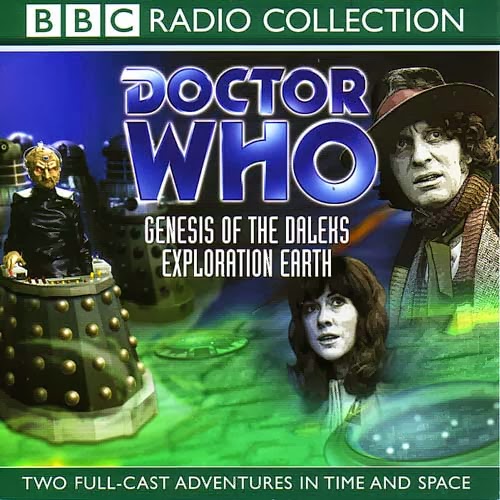
Exploration Earth: The Time Machine


1 episode. Approx. 20 minutes. Written by: Bernard Venables. Produced by: David Little.


THE PLOT

The TARDIS is pulled back in time... Way back, to the creation of the Earth. The Doctor takes this opportunity to show Sarah Jane exactly how her world began. Using a two-person capsule, he takes his companion in close. As they move forward in time, he describes how the chaos unfolding all around - from space gas to volcanic fury - will result in the evolution of an ordered planet teaming with life.

But not if the Megron (John Westbrook) has his way. A member of the chaos-worshipping Carion race, the Megron insists that this world will remain a bastion of chaos forever. "Order will never come!" the Megron insists."There is no air for creatures to breathe. Only gases, totally smothering... There can be no life!"

Leaving the Doctor to confront the Megron in a battle for the future of the Earth...


CHARACTERS

Given its short running time and educational brief, it would be ridiculous to give a detailed look at the characterization. Tom Baker and Elisabeth Sladen bring their usual energy to bear and, to his credit, Tom plays it straight, showing no less commitment to the role here than he was at this point of the television series. Sladen gets the worst of it, having to stand in for the slowest of schoolchildren as she repeats variations of "What's that, Doctor?" throughout. Even the Doctor gets impatient with her at one point, snapping at her to "Stop whittering!" No surprise that, when Exploration Earth was metnioned in the bonus interview with Sladen on The Pescatons CD, she had nothing good to say about her role in this particular piece.


THOUGHTS

Much like Doctor Who and the Pescatons, this story marks a milestone for audio Who. This was the first Doctor Who audio story made for broadcast. It was also the first truly full-cast Doctor Who audio play. As opposed to the almost entirely-narrated Pescatons, all the action in this story is fully dramatized. Finally, it was the first Who story made for another series. Though I will refer to this as Exploration Earth for the sake of convenience, that was actually the name of the show for which it was made, an education radio series made for schoolchildren.

As with The Pescatons, it's of more value as a curiosity piece than as a Doctor Who story. But it's an amiable enough curiosity piece, one whose reach doesn't exceed its twenty-minute grasp. The Megron/Doctor arguments are there to create something resembling conflict, but the focus throughout is the Doctor giving Sarah Jane a very quick primer on the Earth's creation. As an educational tool, it's passable. As a story, it at least doesn't feel rushed - though I question whether the Megron was actually necessary, particularly given that an alien chaos monster doesn't really belong in a science program.

Really, I don't have much else to say about this. It's a functional twenty minute educational audio drama, and it's no chore to listen to. Given that Tom Baker and Elisabeth Sladen made only two Who audios together - this and The Pescatons - it is probably worth a listen on that basis alone.


Overall Rating: 5/10.

Search Amazon.com for Doctor Who

4th Doctor Audio Review Index

4th Doctor Television Review Index

BBC Classic Series Audios Review Index

To receive new review updates, follow me:

On BlueSky:

On Threads: